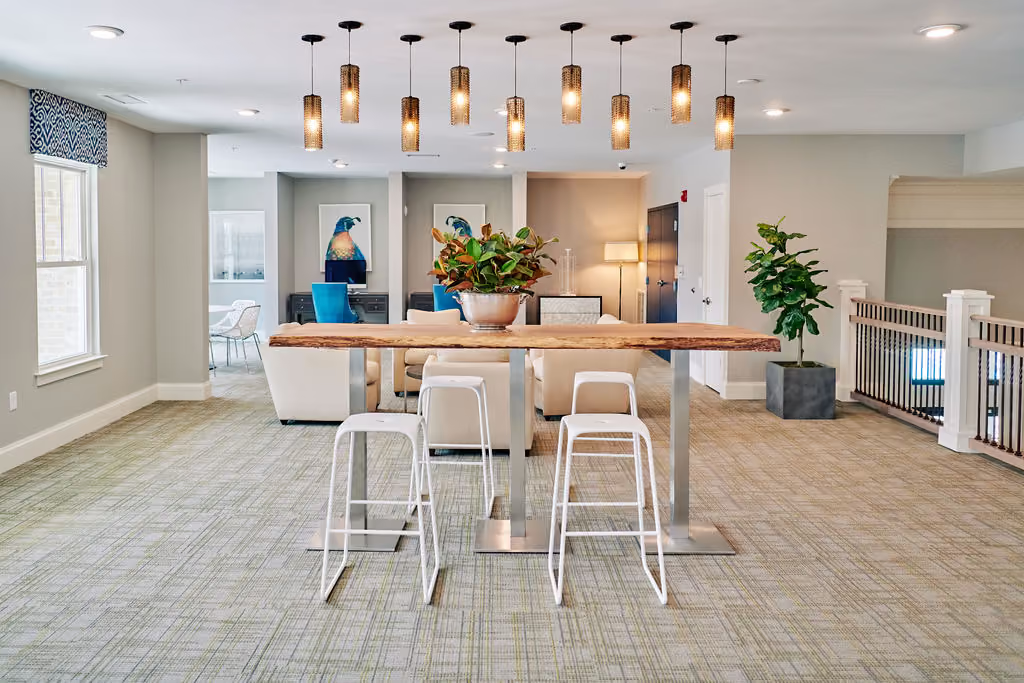
What fiber types perform best in high-traffic carpet applications and what distinguishes each?
Nylon is the benchmark fiber for high-traffic carpet applications because of its exceptional resilience — the ability to recover its pile height after compression — and its resistance to abrasion and matting under sustained foot traffic. It is the consistent professional recommendation for hallways, office lobbies, and any space that sees continuous heavy use. Polyester is a viable alternative in residential high-traffic areas where stain resistance is a priority and traffic volume is moderate — it naturally repels stains but compresses under sustained traffic in ways that nylon resists. Olefin is best specified for areas prone to moisture and spills rather than pure foot traffic — its moisture and mildew resistance makes it appropriate for commercial and outdoor-adjacent applications, but its resilience limitations make it a poor choice for main living areas or corridors.
How does pile type affect carpet durability in high-traffic areas?
Pile type determines how carpet fibers are structured and how they respond to compression, foot traffic, and wear over time. Loop pile carpets — where yarn loops remain uncut — are the strongest performers in heavy-use applications because the loop structure distributes compression stress across both legs of each fiber rather than concentrating it at a single tip. Berber is the most widely recognized loop pile style and is a consistent top recommendation for both residential and commercial high-traffic applications. Frieze or twist pile carpets use tightly twisted cut fibers that return more consistently to their original position after compression — hiding footprints, wear patterns, and minor soil in ways that straight cut pile cannot. Cut and loop combination styles provide a textured surface that camouflages wear while offering more design flexibility than straight loop constructions.
Why does color and pattern selection matter for high-traffic carpet performance?
Color and pattern choice directly affects how acceptable the carpet's appearance remains between cleaning cycles — which in a high-traffic area determines the practical service life of the installation as much as fiber durability does. Darker colors such as gray, brown, and navy hide staining and soiling better than light neutrals under the same traffic conditions. Patterned carpets — whether the pattern comes from color variation or textural differences between loop and cut areas — create visual complexity that disguises footprints, minor staining, and wear in ways that solid colors cannot. Multi-toned and heathered designs are particularly effective because variation across complementary tones makes any single soil particle or wear mark harder to locate against the overall surface. For commercial environments specifically, patterned carpet maintains a professional appearance significantly longer between cleaning cycles than solid alternatives.
What are the best carpet options for high-traffic residential areas?
Three carpet types consistently outperform alternatives in high-traffic residential applications. Berber carpet's looped construction and dense structure resist matting and crushing in hallways, stairs, and living areas where daily foot traffic is concentrated. Frieze carpet's tightly twisted fibers provide durability alongside a casual textured appearance that works well in family rooms and active household corridors — the twist in the fiber hides wear patterns and tracks that straight-pile carpet makes immediately visible. Patterned cut and loop carpet offers the practical benefit of surface texture that camouflages wear combined with design versatility that allows aesthetic alignment with the home's décor. All three perform significantly better than plush or high-pile constructions in residential high-traffic applications where appearance maintenance between professional cleaning cycles is a priority.
High-traffic areas in your home or business require flooring that can stand up to heavy use while maintaining its appearance and durability. When choosing the right carpet for these spaces, it’s essential to consider not only aesthetics but also factors like durability, stain resistance, and ease of maintenance. At Flooring Services LLC, we’ve been helping homeowners and businesses in Charleston and the Lowcountry, find the perfect carpet for high-traffic areas since 1999. Let us guide you through what to look for when selecting a carpet that can withstand the hustle and bustle of daily life.
Key Considerations for High-Traffic Carpeting
1. Durability:
When selecting carpet for high-traffic areas such as hallways, living rooms, or commercial spaces like office lobbies, durability is key. Look for carpets made from strong, resilient fibers that can handle constant foot traffic without showing signs of wear. Some of the best materials for durability include:
- Nylon: Known for its toughness, nylon is one of the most durable carpet fibers available. It resists crushing and matting, making it ideal for high-traffic areas.
- Polyester: While not as durable as nylon, polyester carpets are stain-resistant and offer excellent value for money, especially in residential high-traffic areas.
- Olefin (Polypropylene): Olefin is highly resistant to moisture, stains, and mildew, making it a great option for commercial or high-traffic areas prone to spills.
2. Stain Resistance:
Spills and dirt are inevitable in high-traffic areas. Choosing a carpet with built-in stain resistance can help prolong its lifespan and keep it looking fresh. Consider carpets that have been treated with stain-blocking technology or opt for materials like polyester, which naturally repel stains.
3. Pile Type and Height:
The type of pile, or the way carpet fibers are looped or cut, plays a big role in how well the carpet holds up in high-traffic areas. For these spaces, shorter pile carpets are generally more durable than high-pile options. Here are some types of piles that work well for heavy use:
- Low Pile/Loop Pile: Loop pile carpets, especially those with low, tight loops, are extremely durable and resistant to crushing. This makes them a top choice for high-traffic commercial spaces.
- Cut and Loop Pile: This style combines loops and cut fibers, providing durability with a more textured look. It’s a popular choice for homeowners looking for something stylish yet functional.
- Frieze (Twist) Pile: With tightly twisted fibers, frieze carpets offer durability and hide dirt and wear well, making them a solid choice for busy households.
4. Color and Pattern:
The color and pattern of your carpet can make a significant difference in how well it hides dirt, stains, and signs of wear. For high-traffic areas, consider:
- Darker Colors: Darker shades of carpet, such as gray, brown, or navy, tend to hide stains and dirt better than lighter colors.
- Patterns: Carpets with subtle patterns or textures can help disguise footprints, dirt, and minor stains, keeping your space looking cleaner for longer.
5. Easy Maintenance:
High-traffic areas naturally accumulate more dirt, so it’s important to choose a carpet that is easy to clean and maintain. Nylon carpets are generally easier to clean due to their fiber structure, while low-pile carpets trap less dirt and debris than high-pile options. Regular vacuuming and occasional deep cleaning are key to maintaining the look and longevity of your carpet.
Best Carpet Options for High-Traffic Residential Areas
If you're selecting carpet for your home, especially in busy spaces like hallways, stairs, and living rooms, look for the following:
- Berber Carpet: Known for its looped construction and durability, Berber is a popular choice for high-traffic residential areas. It resists matting and offers great stain resistance.
- Frieze Carpet: This tightly twisted carpet provides excellent durability and a casual, textured appearance that works well in family rooms and hallways.
- Patterned Cut and Loop: Combining different textures helps hide wear and dirt, making it a stylish yet practical choice for your busiest rooms.
Best Carpet Options for High-Traffic Commercial Spaces
Commercial spaces like offices, hotels, and retail stores need carpets that can withstand daily wear and tear while still looking professional. Consider these options:
- Commercial Loop Carpet: Often made from durable fibers like nylon or olefin, commercial loop carpets are designed for heavy foot traffic. Their low profile and tight loops offer both durability and a clean, modern look.
- Carpet Tiles: For commercial settings, carpet tiles are a versatile and practical choice. They offer the durability of traditional carpets but with the added benefit of being replaceable in sections, reducing maintenance costs over time.
Why Flooring Services LLC is the Right Choice
At Flooring Services LLC, we understand the importance of choosing the right carpet for high-traffic areas. With over two decades of experience and access to nearly every variety and brand of carpet, we can help you select a durable, stylish option that meets your needs. From homes to large commercial projects, no job is too big or too small for our expert team. Plus, our professional installation ensures that your carpet is installed correctly and will stand the test of time.
Contact Us Today!
Ready to find the perfect carpet for your high-traffic areas? Contact Flooring Services LLC to schedule your in-home or business consultation and receive a free estimate. With our mobile showroom, we’ll bring samples to you. Our team is here to help you make the right choice for your space, ensuring long-lasting beauty and durability.
What makes high-traffic carpet specification fundamentally different from standard carpet selection and why do general-purpose carpets fail in demanding applications?
- High-traffic carpet specification requires evaluating performance variables that standard residential carpet selection deprioritizes — resilience, fiber abrasion resistance, pile recovery rate, and density — because these are the variables that determine whether the carpet looks acceptable after two years of heavy use rather than how it feels underfoot on the showroom floor.
- Resilience is the most important performance characteristic for high-traffic carpet and the one most directly correlated with how long a floor maintains its original appearance. A carpet that flattens and stays flat under foot traffic looks worn within one to two years regardless of its stain resistance or initial softness — resilience is what separates a carpet that recovers from each footstep from one that accumulates compression permanently.
- General-purpose residential carpets optimized for softness and low price points sacrifice the fiber density and pile construction that high-traffic durability requires. A plush, deep-pile carpet that feels luxurious in a bedroom becomes a matted, crushed-looking surface in a hallway within months — not because of a product defect but because of a specification mismatch between product capability and application demand.
- The visible failure mode of an underspecified high-traffic carpet — matting, crushing, and lane wear — cannot be reversed by cleaning. Once fibers have been permanently compressed beyond their recovery capacity, the appearance degradation is structural rather than surface-level, and replacement is the only correction. This is why correct initial specification is more economical than frequent replacement of underspecified product.
- Commercial high-traffic specifications carry performance ratings and certifications that residential carpet does not — heavy commercial traffic ratings indicate that the carpet has been tested against standardized wear simulations that verify performance under defined conditions. These ratings provide a verification framework that purchasing decisions should reference explicitly rather than relying on general marketing claims.
- Flooring Services LLC's access to nearly every variety and brand of carpet in both residential and commercial categories means specification recommendations are based on product performance data and application experience rather than inventory limitations — the carpet recommended for a specific high-traffic application is the one that performs best in that application, not the one most readily available.
How do nylon, polyester, and olefin carpet fibers compare in real high-traffic performance and which applications suit each best?
- Nylon's molecular structure is the source of its resilience advantage — the polymer chains in nylon fiber compress under load and return to their original configuration more completely than polyester or olefin, producing the pile recovery that high-traffic applications require. This is not a marginal difference in demanding environments; it is the distinction between a floor that looks good after five years and one that looks worn after two.
- Nylon's abrasion resistance under sustained foot traffic exceeds polyester and olefin at the fiber-to-fiber contact level within the pile structure — where fibers rub against each other with each footstep and gradually degrade through friction. This internal abrasion resistance compounds over the installation's lifetime in ways that fiber density alone cannot compensate for.
- Polyester's inherent stain resistance is its most commercially significant performance advantage and makes it a legitimate specification for residential high-traffic areas where staining risk from children, pets, and food and beverage contact is the primary concern. Its resilience limitation becomes consequential in the highest-traffic zones — central hallways, main stairways, and office corridors — where nylon's recovery advantage is most apparent.
- Olefin's moisture and mildew resistance is its defining performance characteristic and the only context in which it is the strongest specification among all fiber types. Basement recreation rooms, mudrooms, commercial spaces with frequent spill or moisture exposure, and outdoor-adjacent applications where standard fibers would develop mold or mildew issues are the correct application range for olefin.
- The resilience failure mode of olefin — permanent compression in traffic lanes — develops faster than in polyester and significantly faster than in nylon under identical traffic conditions. Olefin correctly specified in moisture-appropriate applications performs excellently within its capability range; olefin incorrectly specified in main living areas produces visible lane wear within one to two years that replacement is the only way to address.
- For commercial high-traffic applications in Charleston and the Lowcountry, nylon — particularly in loop pile and commercial carpet tile formats — is the specification that Flooring Services LLC most consistently recommends because it delivers the resilience, cleanability, and appearance retention that commercial environments require across multi-year service cycles without the maintenance premium that other fiber types impose.
How do pile type and pile height interact to determine carpet durability in high-traffic applications?
- Loop pile carpet's uncut yarn structure is the construction type that most reliably delivers high-traffic performance because the loop distributes compression load across both fiber legs simultaneously rather than concentrating it at a single cut tip. This structural advantage means loop pile carpets resist crushing under sustained foot traffic in ways that cut pile constructions of equivalent fiber quality cannot match.
- Tight, low loop constructions within the loop pile category outperform loose or high loop variants in demanding applications because tighter loops have less range of motion to deflect under compression and less distance to recover from deflection — producing a surface that remains more dimensionally consistent under traffic than loose or high loop constructions that can snag, pull, or compress unevenly.
- Berber carpet's distinctive appearance — the flecked, natural-looking texture that defines the style — comes from its loop construction and multi-toned fiber, which simultaneously produces the durability advantage of loop pile and the soil-camouflaging advantage of multi-toned color variation. This combination of structural and visual performance makes Berber the recommendation that recurs across the widest range of high-traffic applications.
- Frieze carpet's tightly twisted cut fiber produces a surface that mimics loop pile's performance characteristics through a different mechanism — the twist in each fiber causes it to curl rather than lying flat after compression, recovering to an upright position that approximates the pile recovery of loop construction while allowing the softness of cut pile that some residential applications prioritize over maximum durability.
- Pile height is inversely related to durability in high-traffic carpet applications — shorter pile resists crushing because fibers have less distance to deflect and less recovery distance required after compression. The plush, deep-pile constructions that feel most luxurious underfoot are precisely the constructions that show traffic lane wear most rapidly, making pile height the specification variable where comfort preference and durability requirement most directly conflict.
- Cut and loop combination constructions offer design flexibility that single-construction pile types do not — the height variation between cut and loop areas creates surface texture that camouflages wear and soil while allowing pattern creation through structure rather than only through color. For homeowners who want visual interest alongside high-traffic performance, cut and loop styles represent the best available balance of both.
What color, pattern, and texture strategies produce the most durable-looking high-traffic carpet installation over time?
- The goal of color and pattern selection for high-traffic carpet is extending the interval between visible wear and cleaning events — not just matching the room's décor. A carpet that requires cleaning to look acceptable after three days of use imposes a maintenance burden that accelerates the cost cycle and the timeline to replacement; a carpet that looks acceptable after two weeks of the same traffic is a meaningfully better specification regardless of its other attributes.
- Multi-toned and heathered designs outperform solid colors in soil camouflage because variation between complementary tones makes any individual soil particle harder to detect against the overall surface. A heathered gray with brown and taupe tones hides far more than a solid gray of the same shade because soil must contrast against multiple simultaneous tones to become visible rather than against a single reference color.
- Medium value colors — neither very light nor very dark — perform best across the broadest range of soil types because they occupy the visual range where both the light debris that shows on dark colors and the dark soil that shows on light colors are simultaneously least visible. Mid-toned warm neutrals are the consistent recommendation across residential and commercial high-traffic applications for this reason.
- Pattern scale relative to room size affects how effectively the camouflage benefit operates in practice. A pattern too small for the room reads as texture rather than pattern and loses much of its soil-disguising benefit. A pattern scaled appropriately to the space creates the visual complexity that makes individual soil particles and wear marks difficult to locate against the overall design.
- Textural pattern created through pile construction variation — the cut and loop approach — produces a camouflage effect that does not depend on color at all, making it effective under a wider range of lighting conditions than color-based pattern. The same traffic lane that becomes visible against a solid-color surface disappears against a textured surface because the texture creates competing visual reference points that the traffic lane cannot dominate.
- Commercial color selection for professional environments must balance brand alignment with practical performance in ways residential selection does not. Many successful commercial installations in the Charleston market achieve this by selecting a multi-toned carpet in a color family adjacent to the brand palette rather than an exact brand color match — preserving the visual association while gaining the soil-camouflage performance that multi-toned design provides.
What distinguishes residential from commercial high-traffic carpet specifications and how should each approach the selection process?
- Commercial carpet carries performance ratings that residential carpet does not, reflecting the more standardized and quantifiable traffic demands of commercial environments. Heavy commercial traffic ratings confirm that the carpet has been tested against industry-standard wear simulations — a verification framework that should be referenced explicitly in commercial specifications and that homeowners installing carpet in unusually demanding residential applications should also consider.
- Residential high-traffic carpet for homes with children, pets, and active households should be specified to commercial performance standards even in residential installation contexts. The traffic demands that active family homes impose on entry halls, main staircases, and central living areas frequently exceed what standard residential-rated carpet is designed to withstand — and the consequence is premature wear in the locations where appearance matters most.
- Carpet tiles are the strongest commercial specification for the highest-traffic zones in office, retail, and hospitality environments because damaged or heavily worn sections can be replaced individually rather than requiring full-room replacement. The replaceability of specific tiles at traffic lane locations — where wear concentrates predictably — extends the effective service life of the broader installation at a fraction of full replacement cost.
- Commercial loop carpet in nylon or olefin — designed specifically for heavy foot traffic with low profile and tight loop construction — is the specification that most commercial environments in Charleston require. Its durability, cleanability, and professional appearance at significantly lower pile height than residential carpet makes it the appropriate baseline for office lobbies, hotel corridors, and retail floor space.
- Warranty terms differ significantly between residential and commercial carpet in ways that affect total value. Commercial warranties often include specific wear performance guarantees expressed in years under defined traffic conditions — more meaningful protection than residential warranties that cover manufacturing defects without addressing performance under use. Understanding warranty terms is a specification decision, not an afterthought.
- Flooring Services LLC's mobile showroom brings samples directly to homes and businesses across Charleston and the Lowcountry — allowing homeowners and commercial decision-makers to evaluate colors, textures, and pile constructions in the actual space and lighting conditions of the installation rather than under showroom conditions that may not reflect how the product will look in its intended environment.
What maintenance practices most effectively extend the performance and appearance life of high-traffic carpet in both residential and commercial settings?
- Daily vacuuming in high-traffic zones is the single highest-return maintenance investment because it interrupts the mechanism that does the most cumulative damage to carpet fibers — fine abrasive soil particles migrating progressively deeper into the pile where they cut fiber surfaces with every subsequent footstep. Vacuuming before this migration occurs prevents the irreversible fiber damage that no amount of deep cleaning can reverse once it has accumulated.
- Walk-off mats at all exterior entry points capture the majority of tracked-in soil before it distributes across the carpet surface — industry estimates suggest mats at entry points capture up to 80 percent of the soil that would otherwise reach interior carpet. In Charleston's environment where sand, pollen, and seasonal moisture are consistent tracked-in contaminants, entry mats reduce cleaning frequency and slow the abrasive wear rate that this particulate causes.
- Professional hot water extraction cleaning — steam cleaning — reaches the embedded soil at the base of the pile that vacuuming cannot remove. This embedded soil causes the gray, dingy appearance that surface cleaning cannot address — and it continues acting as an abrasive with every footstep until professional extraction removes it. Annual professional cleaning is the residential minimum for high-traffic areas; commercial spaces with higher soil loads typically require quarterly service.
- Stain resistance treatment reapplication after professional cleaning restores the protective coating that cleaning processes partially remove. Many carpet owners skip this step and experience declining stain resistance between cleaning cycles that they attribute to fiber degradation when it is actually coating depletion. Reapplication immediately after professional cleaning while fibers are clean and prepared to accept treatment extends stain resistance significantly between cleaning events.
- Immediate spot treatment of spills before they set converts most potential permanent stains into fully resolved incidents. The window between a spill occurring and it bonding to carpet fibers is measured in minutes — keeping carpet-appropriate spot treatment supplies accessible during events and daily use rather than stored away allows the rapid response that prevents the majority of staining that professional cleaning must later address.
- Flooring Services LLC's professional installation ensures that maintenance begins from the correct foundation — correctly stretched carpet without seam failures, appropriate padding underneath, and proper transition strip installation at flooring boundaries. Installation quality determines whether the specified product delivers its rated performance across its full service life or underperforms it due to installation conditions that accelerate wear at seams, along walls, and in transition areas.